
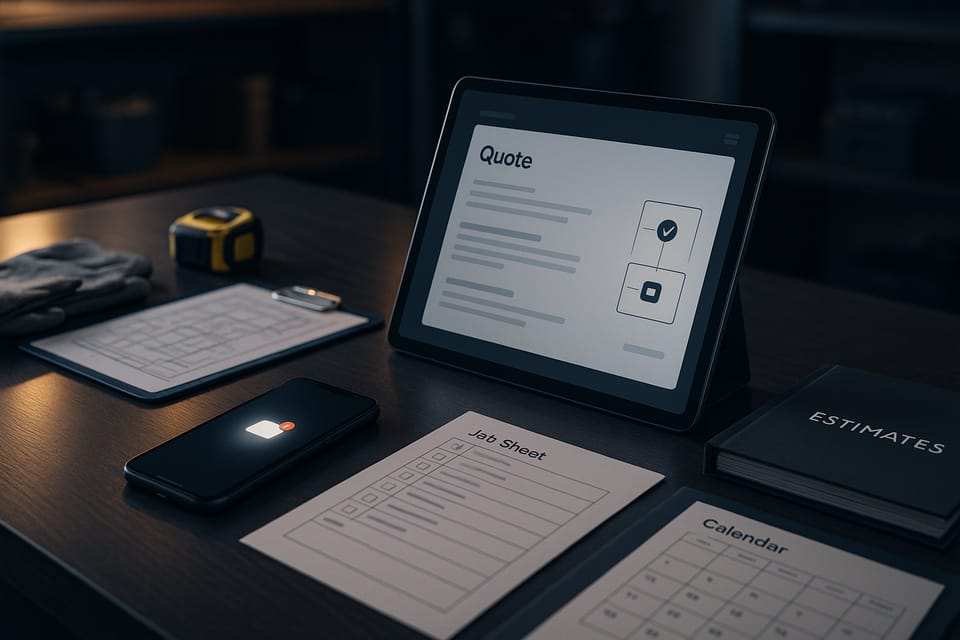
Picture a familiar end to the day. You have been on site since early morning, taken calls between jobs, sent a few quotes when you could, and now it is evening. Somewhere in your inbox are customers who asked for a price, received it, and then went quiet. Some may still be interested. Some may have questions. Some may simply be waiting for a nudge. But if nobody follows up, a warm lead cools down quickly.
That is why quote chase automation for UK trades matters. Many firms do not have a lead problem. They have a follow-up problem. Enquiries come in through Google, Checkatrade, referrals, social media, or repeat customers. The leak appears later, in the gap between sending a quote and getting a decision. For busy field-service businesses, that gap is often filled with site work, driving, scheduling, invoices, and interruptions. Follow-up becomes reactive, then delayed, then forgotten.
Why trades businesses lose jobs after the quote is sent
It is easy to assume a lost job was lost on price. Sometimes that is true, but it is rarely the whole story. Homeowners and commercial customers often request multiple quotes and compare not just cost, but how easy each business is to deal with. Checkatrade guidance on homeowner hiring behaviour consistently points to the importance of responsiveness and professionalism in winning work, especially when customers are comparing several providers at once [2].
Broader sales research supports the same principle. Harvard Business Review's widely cited work on lead response found that conversion odds fall sharply as response time stretches out [3]. Trades quoting is not identical to online sales, but the commercial logic is similar: a customer who was engaged on Monday is less engaged by Thursday if nothing has happened since the quote landed.
The reason this slips is usually capacity, not carelessness. Xero's UK small-business research highlights the ongoing burden of admin and operational pressure on owners [4], while the Federation of Small Businesses and the British Chambers of Commerce regularly point to time pressure, cashflow strain, and limited capacity as persistent barriers to growth [5] [6]. In plain English, most trades owners are not failing to follow up because they do not understand its value. They are failing because the process depends on memory at the exact moment the business is busiest.
What quote chase automation actually means in practice
Automation here does not mean replacing the personal side of a trades business. It means creating a reliable sequence of actions after a quote is sent, so the routine parts happen every time. The owner still handles judgment, pricing, negotiation, and the final relationship. The system handles the repetitive chasing.
A practical sequence usually includes:
- Immediate acknowledgement: a short message confirming the quote has been sent and inviting questions.
- Timed reminders: a polite follow-up after a sensible interval, then another if there is still no reply.
- FAQ handling: quick answers to common questions about availability, deposits, insurance, timescales, or next steps.
- Expiry nudges: a reminder before the quote validity period ends, where relevant.
- High-intent alerts: a prompt to the business when a customer replies positively or asks to proceed.
This is the same kind of operational gap that a well-designed Trades automation setup is meant to close. The goal is not to make the business sound robotic. The goal is to make sure no quote disappears into silence because everyone was out working.
Where automation creates the biggest gains for trades firms
The best place to start is not everywhere at once. It is the point where the current process is most obviously leaking time, revenue, or service quality. For most trades businesses, that means the first few days after a quote is issued.
Immediate confirmation matters because it removes uncertainty. Customers know the quote has been sent, what to look for, and how to reply. Timed reminders matter because they replace memory with process. FAQ handling matters because many customers are not saying no; they are simply waiting to ask a question. And high-intent alerts matter because they tell you exactly who to call first.
There is also a wider digital-adoption case for this. Lloyds Bank's UK Business Digital Index has repeatedly shown that even basic digital tools can improve responsiveness and efficiency for smaller firms [7]. UK government guidance around practical digital adoption has made a similar point: the strongest tools are often the ones that solve a specific operational problem without adding unnecessary complexity [8].
If missed calls are part of the same problem, it is worth looking at how AI voice agents for UK SMEs can support first response outside working hours. And if you are reviewing systems more broadly, the guide to avoiding AI automation failures in 2026 is useful for understanding where small-business projects usually go wrong.
How to automate follow-up without sounding robotic
The main objection from trades owners is reasonable: nobody wants follow-up messages that sound spammy, generic, or pushy. Good automation avoids that by getting three things right: timing, tone, and relevance.
Timing means sensible spacing. A reminder after 48 hours can be helpful. Several messages in quick succession can feel desperate. Tone means plain language that sounds like a real business owner, not a template from a call centre. A short message such as, "Hi Sarah, just checking you received the quote for the bathroom work. Happy to answer any questions," is far more effective than stiff, over-formal wording. Relevance means matching the follow-up to the job. A boiler service, a rewire, and a large extension should not all be chased in exactly the same way.
This is also where governance matters. If you are using automation that stores customer details or triggers outbound messages, the process should be proportionate and clear. For a broader compliance view, see the guide to AI automation and UK GDPR for SMEs. The practical rule is simple: automate the routine steps, keep the wording human, and make it easy for the customer to reply to a person when needed.
A simple ROI check before you change anything
Before investing in any system, do a quick back-of-envelope calculation. How many quotes do you send in a typical month? What is your average job value? How many quotes currently go unanswered for more than five days? If you recovered even one or two additional accepted jobs each month through better trade quote follow up, what would that be worth?
For many firms, the answer is enough to matter. If you send 20 quotes a month and the average accepted job is worth £800, recovering two extra jobs adds £1,600 in monthly revenue. Over a year, that is meaningful. And unlike buying more leads, this gain comes from work you were already close to winning.
There is also a less visible return. Better automation for trades businesses reduces the mental load of remembering who needs a chase, who asked a question, and which quote is about to expire. Small Business Britain has repeatedly emphasised the productivity value of fixing one clear operational bottleneck properly, rather than trying to transform everything at once [9]. Quote follow-up is one of those bottlenecks.
Where to start if you want a practical first step
The most useful starting point is a short process review, not a software shopping spree. Look at where quotes currently go out from, who follows up now, how often that follow-up actually happens, and what customers most commonly ask after receiving a price. In many businesses, the first automation worth building is simply: quote sent, acknowledgement delivered, first reminder scheduled.
- List the channels you use for quotes: email, quoting software, WhatsApp, or a mix.
- Check who owns follow-up today and where it usually breaks down.
- Count how many quotes go quiet for more than five days.
- Write down the top five customer questions after a quote is sent.
- Define the exact signal that means a lead is ready for personal follow-up.
That exercise usually makes the next step obvious. Most firms do not need a complex AI stack to win more accepted jobs trades-wide. They need a dependable system that responds quickly, nudges politely, and alerts the right person when a customer is ready to move. If that system also keeps the owner off the phone after hours, it is solving two problems at once.
To see the full set of AI automation workflows Silverstone AI builds for UK trades businesses — from quote follow-up and missed-call capture to ETA notifications and scheduling — visit the trades automation page.
References
- Silverstone AI, AI Automation Services.
- Checkatrade, Homeowner hiring behaviour and tradesperson response expectations.
- Harvard Business Review, The Short Life of Online Sales Leads.
- Xero, The State of Small Business UK.
- Federation of Small Businesses, Small Business Index and policy research.
- British Chambers of Commerce, Quarterly Economic Survey.
- Lloyds Bank, UK Business Digital Index.
- UK Government, Help to Grow Digital guidance.
- Small Business Britain, Small Business Growth and Productivity Report.