
Why trades businesses lose jobs after the quote is sent
The pattern is familiar across plumbing, electrical, roofing, heating, building, decorating, and other field-service trades. A customer gets in touch, a site visit happens, the estimate is prepared, and the quote goes out. Then nothing. Not always because the customer chose someone else, but often because nobody followed up while the job was still fresh in their mind.
In owner-managed firms, follow-up usually depends on spare time. That is the problem. Spare time disappears when the van is moving, the day overruns, or the next job needs pricing. Research and commentary from Checkatrade and Rated People consistently point to a market where homeowners compare multiple quotes and place real weight on responsiveness, organisation, and communication quality. In practice, the business that checks in politely and promptly often feels safer to hire.
That makes missed quote follow-up jobs more expensive than they first appear. The business has already paid for the lead, spent time visiting the property, and invested effort in pricing the work. If the quote then sits without a reminder, the loss is not only the job itself but the wasted time and marketing spend that created the opportunity. For small firms under cash-flow pressure, improving conversion can be more valuable than generating more enquiries. That broader point is consistent with Xero's UK small business reporting, which regularly highlights the operational strain on lean businesses.
What quote follow-up automation actually looks like
The phrase automation can sound heavier than it really is. In a small trades business, ai quote chasing for trades is usually not a complex software project. It is a simple workflow that makes sure the right message goes out at the right time without relying on memory.
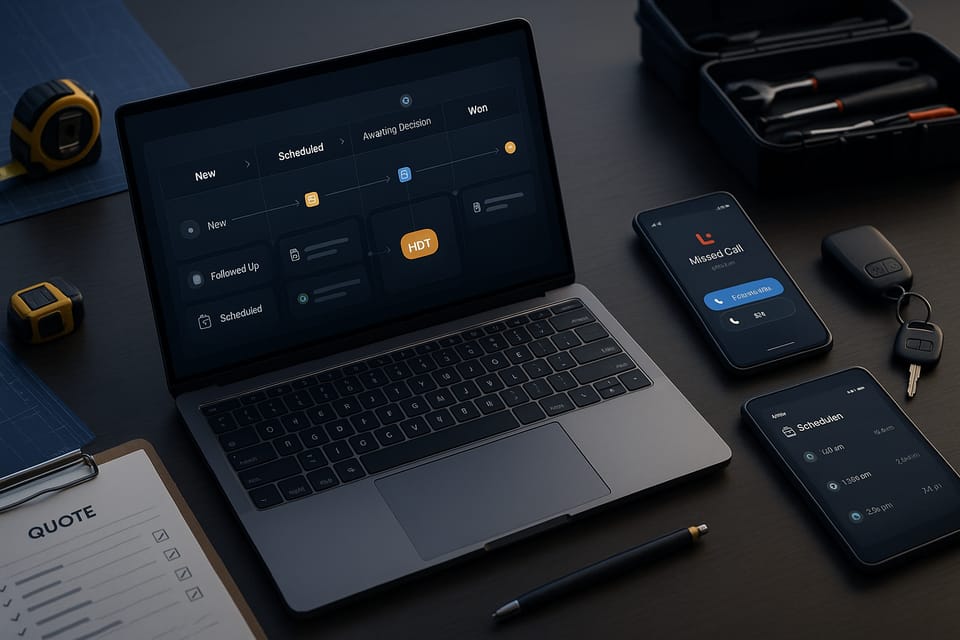
A typical workflow looks like this:
- An enquiry is captured from a call, form, or message.
- The quote is sent as normal by the owner or office admin.
- An acknowledgement confirms the estimate has been sent and invites questions.
- If there is no reply after a set period, a polite reminder is triggered automatically.
- If the customer replies, asks about timing, or requests a start date, the lead is flagged for personal follow-up.
- If there is still no response after a second check-in, the lead is marked inactive rather than sitting forever on a mental to-do list.
This is where a broader trades automation setup becomes useful. If the same system also captures missed calls, logs enquiry details, and routes common questions, the owner gets a cleaner pipeline from first contact through to quote and booking. Businesses exploring that wider layer often also look at AI voice agents for UK SMEs or compare the economics in AI receptionists for UK SMEs: costs and ROI in 2026.
Where automation saves the most time and wins the most work
Quote follow-up automation for trades is most valuable where the customer decision takes time. Roofing, rewires, boiler replacements, bathrooms, kitchens, extensions, and larger repair jobs all involve comparison, budget discussion, and scheduling. In those cases, silence after the quote does not necessarily mean rejection. It often means the customer is still deciding and the business that stays visible, without becoming pushy, has an advantage.
- Longer decision cycles: reminders keep the business present while the customer compares options.
- Missed-call recovery: if the first call is unanswered, the enquiry can still be captured and moved into follow-up.
- Routine question handling: deposits, availability, service areas, and next steps can be answered quickly.
- Lead visibility: owners can see which quotes are pending, replied to, booked, or cold.
Consumer expectations also matter here. Ofcom's Online Nation research supports the wider point that UK consumers increasingly expect convenient, responsive communication from service providers. If a call goes unanswered and no follow-up appears, the customer does not wait patiently forever. They move to the next option. That is why the top of the funnel and the middle of the funnel should connect. A missed call captured by an automated front desk can become a quote request, and a quote request can become a booked job if the follow-up is structured.
For firms trying to avoid overcomplicated systems, the best starting point is usually one painful bottleneck rather than a full rebuild. If you want a broader view of where projects go wrong, this guide to AI automation failures in UK SMEs is a useful reminder that narrow, measurable workflows tend to outperform ambitious but vague rollouts.
Doing it without annoying customers or breaking the rules
One of the most common objections to trade business lead follow-up UK automation is tone. Owners worry that automated reminders will feel robotic, generic, or pushy. That risk is real if the workflow is badly designed. It is much lower if the messages are contextual, limited, and written in plain language.
Good follow-up references the actual job, uses the customer's name where appropriate, and gives them an easy way to reply. It does not send a barrage of reminders. In most cases, one acknowledgement and one timed check-in are enough to improve response rates without creating friction. The system should also stop or escalate when the customer replies, rather than continuing to send messages blindly.
Compliance matters too. The ICO's UK GDPR guidance makes clear that businesses need to be transparent about how they use customer data, keep records sensibly, and avoid using personal information in ways customers would not reasonably expect. For quote follow-up, the legal basis is usually straightforward because the customer initiated contact and the messages relate directly to the requested service. Still, businesses should be clear about how contact details are used and offer a simple way to opt out of non-essential communications. For a practical overview, see AI automation and UK GDPR: a 2026 SME guide.
A practical 30-day rollout for a UK trades firm
The strongest implementations start small. They do not try to automate every call, message, booking, and review request on day one. They begin with the point where revenue is already leaking.
- Week one: map the current journey. Write down what happens from first enquiry to booked job. Include missed calls, site visits, quotes sent, reminders, and accepted work.
- Week two: choose one workflow. For most firms, that is unanswered quote reminders. Set a simple sequence with one acknowledgement and one follow-up after three to five days.
- Week three: connect call answering. If leads are being lost before the quote stage, add a missed-call capture layer or front-desk workflow through your existing tools or a service partner.
- Week four: review the numbers. Track quotes sent, replies received, booked jobs, and admin time saved. Then adjust wording, timing, and escalation rules based on real conversations.
This staged approach fits the reality of small firms. It also aligns with broader UK small-business research from Small Business Britain and the FSB, both of which underline the time pressure on owner-operators and the value of practical digital tools over heavy transformation programmes. If the first workflow works, the next steps are obvious: booking confirmations, review requests, seasonal reactivation, and better enquiry routing.
For businesses comparing options, a general overview of automation services can help frame what should stay simple and what should remain human-led.
The business case in plain numbers
The commercial logic is usually straightforward. Imagine a heating engineer sending fifteen quotes a month at an average job value of £1,200. At a 35% conversion rate, that is roughly five jobs, or £6,000 in monthly revenue. If better follow-up lifts conversion to 50%, the same enquiry volume produces seven or eight jobs instead. That is an extra £2,400 to £3,600 a month without increasing ad spend.
Exact results vary by trade, job value, and local competition, but the principle is consistent: improving response speed and follow-up quality often produces a faster return than trying to buy more leads. Broader consumer-behaviour analysis from Think with Google supports the idea that convenience and responsiveness influence service-business conversion. In other words, the business that is easier to deal with often wins more work even before price becomes the deciding factor.
That is why quote chasing deserves more attention than it usually gets. It sits in the middle of the sales process, after the hard work of generating the enquiry and before the revenue lands. For many trades firms, it is one of the simplest places to improve outcomes without adding office headcount or spending evenings manually chasing every lead.
Conclusion
For UK trades businesses, the revenue leak is often not at the top of the funnel. It is in the gap between quote sent and decision made. When follow-up depends on memory, spare evenings, or a note left in the van, good opportunities go cold for avoidable reasons.
Quote follow-up automation for trades closes that gap with consistent, polite, and well-timed communication. It helps owners stay responsive while they are on site, reduces routine admin, and makes it easier to spot which customers are ready to move. Used properly, it does not replace the human relationship that wins trust. It simply makes sure that relationship is not lost because nobody remembered to send the next message.
For a full look at the AI automation Silverstone AI builds for UK trades businesses — from quote follow-up and lead capture to scheduling, ETAs, and after-hours call handling — visit the trades automation page.
References
- Checkatrade – Trade Business Insights and Homeowner Hiring Behaviour
- Rated People – Home Improvement Trends and Trades Advice
- Xero Small Business Insights UK
- Ofcom Online Nation – Digital Communication Habits in the UK
- ICO – UK GDPR Guidance for Organisations
- Small Business Britain – Digital Skills and Tech Adoption Reports
- FSB – UK Small Business Statistics and Policy Research
- Think with Google – Consumer Behaviour and Local Service Expectations
- Silverstone AI – Automation Services for UK SMEs