
- 8 min read
- AI Receptionists
- July 11, 2026
- AI receptionist UK
What to take from this article
- Understand what an AI receptionist really does in a UK small business.
- See where voice AI creates value and where human handoff must stay in place.
- Use a practical framework to judge readiness, buying options and rollout scope.
Introduction
Missed calls are expensive, but so is a clumsy front desk. The modern answer is not a gimmick bolted onto your phone line. It is a tightly designed reception system that can answer, route, capture, book and escalate with precision across calls, web and messages. For UK small businesses, that matters most when the day is busy, the team is stretched and every new inquiry needs a clean handoff. This is where Silverstone AI approaches AI receptionists as an operating system question, not a chatbot purchase: what should be automated, what must stay human, and how do you keep service standards intact while the business moves faster?
What an AI receptionist actually is
Strip away the marketing language and the useful version is simple.
An AI receptionist is a voice-led front-door system that answers inbound inquiries, understands common requests, follows approved business rules and either completes a bounded task or passes the conversation to a person. In a UK small business, that usually means handling first contact for bookings, opening hours, service questions, lead capture, routing and callback requests.
The important phrase is bounded task. A good AI receptionist does not replace judgment-heavy work. It works best where the business can define clear rules: which calls can be answered, what information can be collected, when a booking can be offered, and when the call must go to a human.
This matters in the UK because small firms often run lean teams, mixed mobile and office coverage, and uneven call peaks across mornings, lunch periods and after-hours. A receptionist system needs to cope with local accents, UK time formats, business-hour rules, consent-aware workflows and practical escalation paths, not just answer politely.
The real question is not whether AI can answer the phone. It is whether your reception logic is clear enough to trust at first contact.
- Best usesAnswering common inquiries, routing to the right team, taking details and handling simple bookings.
- Poor usesClinical judgment, disputes, sensitive complaints, complex pricing or anything needing negotiation.
- Core requirementA clean human handoff with context so staff are not forced to start again.
Where AI receptionists create value for small businesses
The strongest commercial case is operational, not theatrical.
Most small businesses do not need a flashy voice demo. They need fewer missed opportunities, cleaner admin and more consistent first response. That is why AI receptionists create value when they sit inside a wider workflow rather than acting as a standalone tool.
If a caller asks for availability, the system should know whether it is allowed to offer a slot, gather the right details and write that information to the correct destination. If someone calls after hours, the system should know whether to book, log, triage or arrange a callback. If the query falls outside policy, it should escalate immediately.
That operating-system view is why reception AI often overlaps with services, workflow logic and internal process design. The voice layer is only the visible edge. The real gain comes from better routing, fewer manual re-entries and less ambiguity in how new inquiries move through the business.
- Strong fit sectorsTrades, clinics for non-clinical inquiries, salons, hospitality, property and service businesses with repeated call types.
- Strong fit workflowsBooking requests, FAQs, lead qualification, store-and-forward messages and team routing.
- Weak fit workflowsHigh-emotion complaints, safeguarding issues, complex case handling and bespoke quoting without guardrails.
Lead capture
Catch calls that would otherwise ring out, gather structured details and route them to the right owner.
Booking support
Offer approved slots or callback windows when booking rules are clear and controlled.
Staff protection
Reduce interruption load so skilled team members spend less time on repetitive front-desk work.
After-hours cover
Keep the business responsive outside standard hours without pretending every issue can be solved instantly.
The system behind a good AI receptionist
What the caller hears is only one layer. The business logic underneath decides whether the experience feels sharp or chaotic.
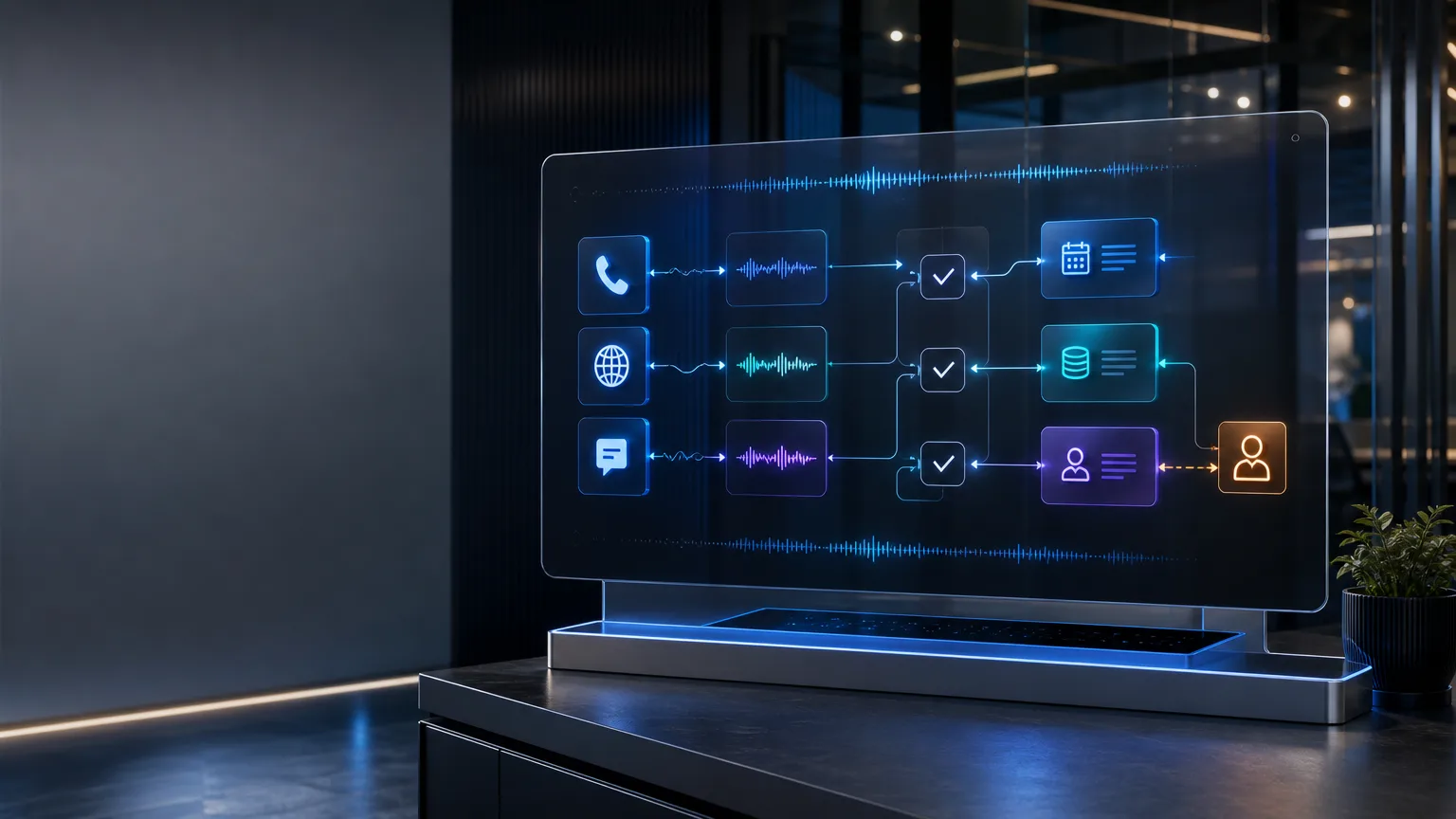
A reliable AI receptionist normally combines five parts: telephony, conversation logic, business rules, destination systems and human exception handling. Remove any one of them and the setup starts to wobble.
Telephony handles the call itself. Conversation logic manages turn-taking, intent recognition and approved answers. Business rules decide what the system may do, such as booking limits or routing rules. Destination systems include calendars, CRMs or inboxes. Human exception handling catches anything uncertain, sensitive or outside policy.
For UK small businesses, the handoff design matters as much as the voice quality. If the system books into the wrong diary, logs unusable notes or transfers without context, it creates admin debt instead of reducing it. This is why implementation discipline matters more than novelty.
A useful rule of thumb
If you cannot write the front-desk policy clearly, you are not ready to automate it. AI receptionists perform well when your service rules are already understandable to a new staff member.
| Decision point | What it covers | Why it matters | Failure risk if weak |
|---|---|---|---|
| Telephony layer | Inbound answering, routing, transfer and call state control | It determines whether callers can actually reach and move through the system cleanly | Dropped calls, poor transfers or confusing call flow |
| Conversation design | Approved prompts, responses, confirmations and fallback wording | It shapes clarity, trust and whether the caller completes the task | Robotic exchanges, misunderstandings or repeated loops |
| Business rules | Opening hours, booking permissions, escalation triggers and stop conditions | It keeps automation inside safe commercial boundaries | Wrong bookings, bad promises or policy breaches |
| Destination systems | Calendar, CRM, forms, inboxes and task creation | It turns the call into a usable operational record | Manual re-entry, lost leads or fragmented data |
| Human handoff | Warm transfer, callback task or escalation path with context | It protects edge cases and preserves service quality | Frustrated callers and duplicated effort |
How to decide whether your business is ready
Readiness is less about company size and more about process clarity.
The best early deployments tend to share three traits. First, the business gets repeatable inquiry types. Second, there is a defined destination for each type of call. Third, management is willing to set boundaries on what the system may and may not do.
If your call handling is currently informal, spread across personal mobiles, or dependent on one person remembering everything, an AI receptionist may still help — but only if you fix the process before the voice layer goes live. Otherwise you automate confusion.
That is also why implementation should connect to a proper delivery method. Pages like how we work and pricing are useful decision points because they frame AI as a system build, not a one-click install.
- Good first stepAudit one week of inbound calls and group them by repeatable intent.
- Next stepDefine clear stop conditions for complaints, safeguarding, pricing disputes or specialist advice.
- Decision testIf a new team member could follow the rule set, an AI workflow can usually be designed around it.
You know the common call types
Your team can list the top inquiries and the correct next step for each.
You have a source of truth
Diary rules, service areas, opening hours and escalation contacts are documented.
Every answer depends on one person
If knowledge lives in someone's head, the system cannot behave consistently.
You expect fully autonomous handling
Reception AI should reduce load, not remove human responsibility for edge cases.
What to ask before you buy or build
The wrong question is 'Can it answer calls?'. Nearly every tool can. The right question is whether it can operate safely inside your business.
A sensible buying process starts with control, not features. Who owns the call flow? Where is the booking truth held? What happens when the system is unsure? How are notes stored? Can the team review transcripts, outcomes and failed paths? These questions matter more than a polished demo.
In the UK, you also need to think practically about privacy, call recording, consent wording where relevant, and sector-specific boundaries. A receptionist for a salon, trade business or estate agency will have different operational rules from one handling healthcare-adjacent or sensitive inquiries. The system must reflect that reality.
For many small firms, a bespoke or semi-bespoke setup is stronger than an off-the-shelf generic voice bot because it can connect to the actual booking, routing and follow-up logic the business already uses. That is the difference between software that sounds clever and a system that becomes useful.
A reception system should make the business easier to run. If it creates more checking, more apologizing or more manual repair, it is not finished.
- Ask about ownershipCan you change prompts, rules, destinations and opening-hour logic without rebuilding everything?
- Ask about exceptionsWhat exactly triggers transfer, callback or human review, and what context goes with it?
- Ask about integrationWill it connect cleanly to your diary, CRM, forms and reporting flow?
- Ask about observabilityCan you review call outcomes and improve weak paths over time?
A pragmatic rollout plan for UK small businesses
Start narrow, prove the workflow, then expand.
The cleanest rollout usually begins with a limited slice of front-desk work: common inbound inquiries, after-hours capture, or one booking path with obvious rules. That gives the business a safe test bed and reveals where information, wording or routing still need work.
From there, review real interactions. Where did callers ask for something outside scope? Which answers were too vague? Which handoffs lacked enough context for the team? Good deployment is iterative. You are tuning a service layer, not pressing a launch button and hoping for the best.
If you are weighing this up now, the next step is usually a workflow conversation rather than a product demo. Book a call, explore more practical thinking on the blog, or use contact if you already know the process gap you need to fix.
Phase 1: Narrow scope
Choose one call family, one destination and one escalation route. Keep the first version small enough to monitor closely.
Phase 2: Measure friction
Review transcripts, failed intents, transfer quality and admin cleanup required by staff after the call.
Phase 3: Expand with rules
Add new pathways only when the underlying policy is clear, owned and testable.
Build the next Silverstone system around your real workflow.
Bring the problem, the current stack and the commercial outcome. We will map the practical route from idea to deployed AI system.
Book a discovery call