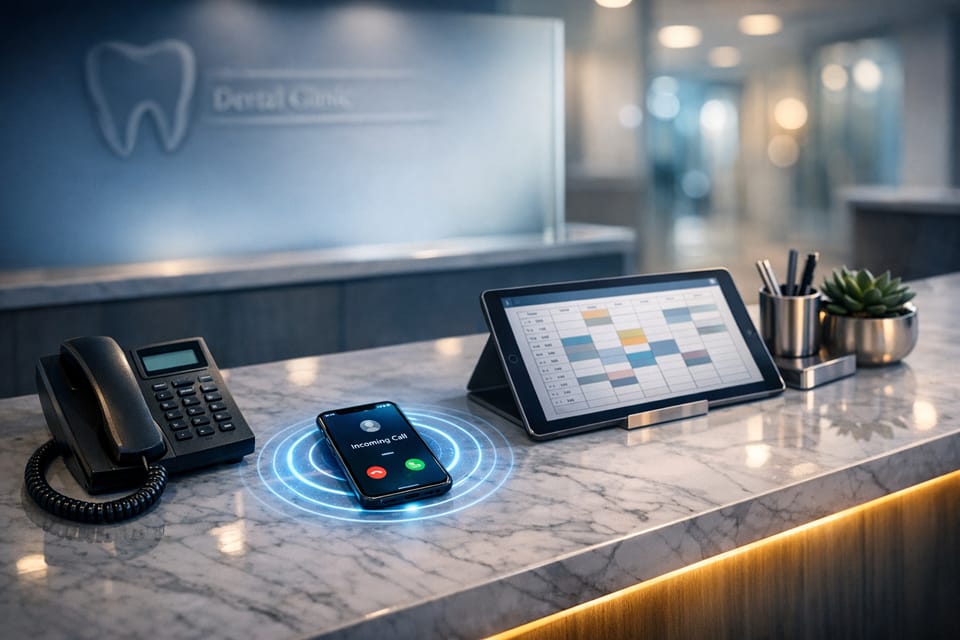
The phone rings at 11:40 on a Tuesday morning. Your receptionist is checking in a nervous patient, a clinician has just started a crown prep in surgery two, and the other line lit up four minutes ago. By the time anyone calls back, the person who rang has already tried the next practice along. They wanted a consultation for Invisalign. They would have been worth £3,000 to £4,500 to your diary.
This is not a staffing failure. It is a structural one. Even a well-run, well-staffed practice has predictable windows every day where inbound calls go unanswered: the morning rush before the first appointment, surgery time, lunch cover, and the period after 5pm when reception has closed. In many practices these windows overlap almost exactly with the times when high-intent patients — new patients, cosmetic enquirers, people in pain — are most likely to call.
AI missed-call recovery is not about replacing your receptionist or removing the human element from patient communication. It is about closing the gap between a call going unanswered and the practice having no way to reach that person again. Done well, it is one of the most commercially useful AI workflows a UK dental practice can run — and one of the more straightforward to implement safely.
Why Missed Calls Cost UK Dental Practices More Than Owners Realise
The instinct is to think of a missed call as a minor inconvenience. In reality, each unanswered inbound call during a busy period represents a patient who was ready to act at that moment.
Dental care demand in England remains under significant pressure. NHS England's dentistry guidance reflects an ongoing backlog of patients seeking routine and urgent access, which has pushed more people toward private options. That demand does not translate automatically into revenue for your practice — it only converts if you capture it.
Private and mixed practices face a particular version of this problem. NHS appointment capacity is often constrained, so practices increasingly rely on converting private enquiries — hygiene plans, cosmetic consultations, implants, orthodontics — to sustain margin. These are exactly the enquiry types that tend to arrive by phone rather than online form, because patients have questions they want answered before they commit. If that call goes unanswered and the practice never follows up, the value disappears entirely.
The CQC's guidance for dental providers also frames patient access and responsiveness as a quality indicator, not just a commercial one. A practice that routinely fails to respond to patient enquiries is not just losing revenue — it is creating an accessibility gap that regulators increasingly take seriously.
Which Enquiries Are Worth Targeting First
Not every missed call carries equal weight, and the best AI missed-call workflows are designed around commercial priority rather than trying to automate everything at once.
The enquiry types most worth recovering first are:
- New patient registrations and first exams. These anchor long-term patient relationships and generate recurring hygiene and recall value beyond the initial appointment.
- Emergency and urgent pain calls. High intent, time-sensitive, and among the most likely to book immediately once reached. These also carry safeguarding and duty-of-care considerations that mean rapid response matters clinically as well as commercially.
- Cosmetic and smile consultations. Invisalign, composite bonding, veneers and whitening enquiries typically come from patients who have already researched their options and are comparing practices. Speed of response is a significant differentiator here.
- Implant enquiries. High-value, long-cycle decisions that benefit from fast, warm follow-up to keep the enquiry engaged before it drifts to a competitor.
- Overdue recall patients. Patients who ring to rebook after a gap are already motivated. A failure to respond promptly often results in another long lapse.
Prioritising by revenue impact and diary value — rather than attempting to automate every call type simultaneously — keeps implementation manageable and gives owners meaningful data to assess what is working within the first 30 to 60 days.
What an AI Missed-Call Recovery Workflow Actually Looks Like
The mechanics are straightforward, which is part of why this is a practical starting point for practices new to AI automation.
Step one: Detection and instant acknowledgement
When a call goes unanswered, the system triggers an automatic SMS or WhatsApp message to the caller within seconds. The message acknowledges the missed call, confirms the practice has seen it, and gives the patient a way to respond — either with a simple reply, a booking link, or a prompt to call back at a time that suits them.
This single step does more than most practices expect. It tells a high-intent caller that the practice is attentive and organised, it prevents them from assuming nobody will ring back, and it creates a structured thread that reception can pick up without needing to remember who called.
Step two: Light qualification
For enquiry types where it is helpful — cosmetic consultations, implant enquiries — the follow-up message can include a short, conversational question or two that helps the team understand what the patient needs before they call back. This is not an interrogation. It is the kind of information a good receptionist would gather in the first 30 seconds of a live call.
Step three: Booking or callback routing
Patients who are ready to book can be offered a direct link to available slots via the practice's existing booking tool. Patients who want to speak to someone first are routed to a callback request, which appears in reception's task queue as a warm lead with context already attached.
Step four: Follow-up if there is no reply
If the patient does not respond within a defined window — typically a few hours to a day, depending on the enquiry type — a gentle follow-up message goes out. If there is still no response, the record closes cleanly without generating further automated contact.
The human handoff points are important. AI handles the acknowledgement, the initial qualification, and the routing logic. Anything that involves clinical assessment, symptom triage, or a patient expressing distress should immediately route to a trained team member. This is not optional — it is the boundary that keeps the workflow safe and compliant.
You can read more about how AI voice and messaging workflows are structured for UK SMEs in our guide to AI voice agents for UK SMEs in 2026.
How to Run This Safely in a UK Dental Setting
Any workflow that handles patient contact details and appointment enquiries touches personal data. In a healthcare setting, some of that data may constitute special category health data under UK GDPR. That raises the compliance bar, and it is worth approaching this carefully before deployment.
The ICO's guidance on AI and data protection is clear that organisations using AI to process personal data must be able to demonstrate lawfulness, transparency, and data minimisation. In practice, for a dental missed-call workflow this means:
- Transparency: Patients should be informed, either in your practice's privacy notice or in the automated message itself, that an AI system is handling their initial response.
- Data minimisation: The system should only capture and retain the information it needs — name, contact number, enquiry type — not open-ended conversation transcripts unless there is a clear and documented reason.
- Record-keeping: Any data processed through the workflow should be retained and deleted in line with your existing patient data retention policy.
- Escalation for urgent or clinical queries: The workflow must not attempt to handle symptoms, diagnoses, or clinical advice. These must route immediately to a clinician or trained team member.
The GDC's Standards for the Dental Team also speak directly to the obligation to put patients' interests first, communicate clearly, and maintain safe systems. An AI workflow that is poorly configured to handle urgent calls, or that responds to a patient in pain with a generic booking prompt, does not meet that standard. Getting the escalation logic right is not a technical nicety — it is a professional one.
The DSIT's introduction to AI assurance for business leaders offers a practical framing for practice owners who want to document their approach to AI governance without needing a technical team.
Our detailed guide on AI automation and UK GDPR covers the data protection requirements that apply to most UK SME automation projects, including those in regulated sectors.
How to Measure ROI in the First 30 to 90 Days
Most practices that pilot missed-call recovery can see meaningful signal within four to six weeks, because the volume of missed calls is usually larger than owners expect when they first look at the data.
Useful metrics to track from day one:
- Volume of missed calls per week — your baseline before automation
- Recovery rate — the percentage of missed calls that generate a reply via the automated workflow
- Booking conversion from recovered calls — how many recovered enquiries result in a booked appointment
- Revenue by enquiry type — what appointment categories the recovered bookings fall into, to assess diary value
- Response time — the gap between a missed call and first contact, before and after automation
A realistic pilot approach for a small or medium-sized practice is to start with one enquiry type — new patient registrations are a common choice because they are easy to identify and have clear lifetime value — and run the workflow for four to six weeks before expanding to other categories.
Practices that are already using AI appointment reminders often find that missed-call recovery integrates naturally with that infrastructure. If this is territory you are exploring, our article on AI appointment reminders for UK small businesses is a practical companion read.
Silverstone AI works with UK dental practices on exactly these kinds of front-desk automation workflows — from initial missed-call capture through to booking confirmation and follow-up sequences that keep the diary full without adding to the reception team's workload.
The Broader Picture: UK SMEs Are Moving From Experimentation to Operational AI
There is broader context here worth noting. Recent analysis of UK SME AI adoption, including coverage of the Jitterbit 2026 AI Automation Benchmark Report and Air IT's 2026 UK SME AI summary, indicates that smaller businesses are moving beyond tentative experimentation and beginning to embed AI in operational workflows. For dental practices, the front desk is the natural starting point: it is where patient relationships begin, where revenue is either captured or lost, and where a targeted automation delivers a measurable return without requiring technical expertise from the team.
The goal is not a fully automated front desk. It is a practice that never loses a high-intent patient to a slow or absent response when the team is doing what it is there to do: treating patients.
References
- NHS England – Dentistry
- Care Quality Commission – Dental services guidance
- General Dental Council – Standards for the Dental Team
- Information Commissioner's Office – AI and data protection guidance
- DSIT – Introduction to AI assurance for business leaders
- Jitterbit 2026 AI Automation Benchmark Report – Enterprise Times
- Air IT – How UK SMEs Are Using AI in 2026
- Silverstone AI – Dentists niche page
- Silverstone AI – Services overview